Despite these facts, the most useful and widely accessible form of media is now decades old and has made no real new technological advancements for quite some time. The medium I am referring to is, of course, radio.
This essay will briefly describe the invention and emergence of radio through the 20th Century. Secondly, it will outline the emergence of radio broadcasts in popular culture and its impact on communication methods worldwide. In doing this, it will discuss the dangers and public interest regarding cross-media ownership. It will then explain why radio still remains the most accessible and convenient form of media delivery to this day; first by comparing it with other communication mediums, and then discussing the options for amalgamation and cross-platform media delivery that it presents with other devices and media forms.
Although not quite the 20th Century, Guglielmo Marconi’s 1895 achievement of transmitting a radio wave across his house is the first recorded use of the science that powers the modern radio. In 1901 he went on to successfully transmit and receive a radio signal across the
…progress in the radio art was marked by isolated experiments leading to the discovery of new scientific principles, rather than by commercial applications (Bucher, 1974)
During the years 1903 to 1914, several American radio companies continued to develop the radio and by the latter years of this period its ability to transmit over distances at sea was significantly increased. The previous inability to communicate with vessels at sea was a defining factor in the interest in transmission over sea When the United States entered the First World War in 1917, all radio development was controlled by the U.S. Navy to prevent its possible use by enemy spies. In 1919, after the government released its control of all patents, the Radio Corporation of America (RCA) was established with the purpose of distributing control of the radio patents that had been restricted during the war (Bellis).
As the decades wore in, the popularity and portability of radio broadcasts grew and soon many people had personal radio sets in their own home. These were not for means of communication however, the general home radio was purely a signal receiver, meaning that it received and played the broadcasts of news and entertainment program’s designed specifically for the medium. A study of radio listeners in
In more recent years, studies of Australian listening habits and satisfaction with radio broadcasts have shown that, “Radio is seen as an essential, habitual, instinctively consumed product” (Federation of Australian Radio Broadcasters, 1979). Listeners feel generally satisfied with the product being delivered to them.
However, their apparent knowledge of the ownership and vested interest in advertising was almost non-existent. Radio consumers do not know, or even care, about who owns and controls commercial radio stations. As well as this, there was no evidence that consumers believed that radio stations have any responsibility to listeners in this regard. Radio is acknowledged as a commercial tool, rather than the formidable means of communication it was regarded as during the earlier half of the century. They did note, however, that radio is not viewed as a highly profitable medium compared to the likes of television and newspapers.
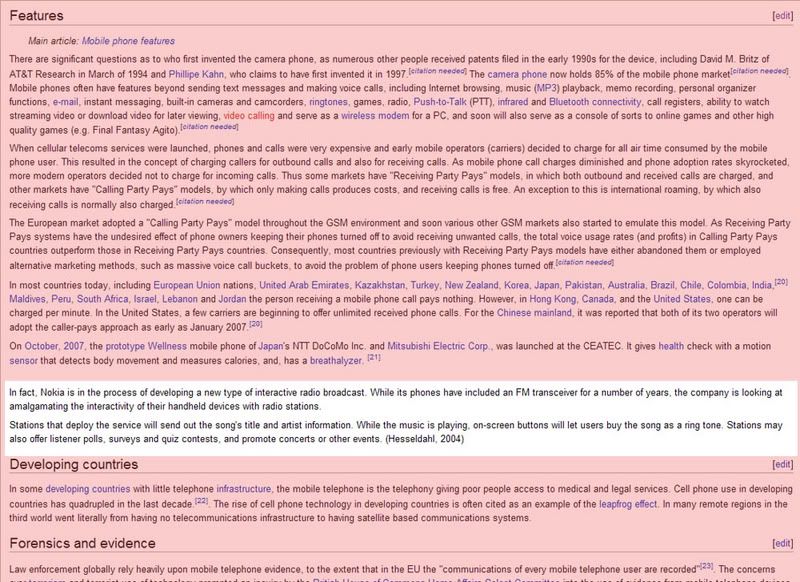
While its contemporaries on the internet may argue otherwise, the place of radio broadcasts is still firmly rooted in the modern news and communication avenues, for several reasons. One of the most defining factors that maintain radio’s dominance in modern media is its portability and accessibility. All cars made in the last few decades have come fitted with radios as standard. Meaning that every single person who owns a car, owns and has access to a radio. Radios have, over time, been made significantly more compact than their original designs, but they still serve the same purpose; to receive transmissions and play them. Most alarm clocks are fitted with radios, all home stereos come with radios, even portable media players and telephones are now fitted with in-built radio receivers.
Its advantages are identified as its mobility, its immediacy and its undemanding nature. It is viewed as more necessary but less involving than television or press [newspapers]. (Federation of Australian Radio Broadcasters, 1979)
Even if you don’t knowingly own a radio, its presence is still unavoidable. Radio is usually played in most public transport as it is a cheap, reliable and constant means of entertainment for passengers. Most retail shops will have either a commercially broadcasted or privately broadcasted radio station playing through their public announcement system. Many restaurants and commercial workplaces will play radio stations through their establishments..


While it is true that the content of radio broadcasts are not as broad and interactive as information found online, the standard set-up cost for a home computer and internet connection are phenomenally greater than that of a simple radio set, making it not only the most portable and accessible media source, but also one of the cheapest.
The actual cost of a radio itself remains as the second cheapest form of entertainment and news that you can purchase outright; the first being the newspaper. But, unlike a newspaper, the content of a radio is not static, and is constantly changing and renewing itself according to the broadcasts it receives from radio stations. The purchase of a single newspaper can provide you with several hundred stories and pieces of information, but at the end of the day your new piece of media is only good as mulch or for cleaning windows. Radio content is infinitely re-newable, the only thing that determines when the content stops is the lifespan of the radio itself and its components.
Unfortunately, radio listeners have begun to lose the idealisation of radio as a communication and information delivery product. It has become so ingrained into daily routine that its accessibility, predictability and dependability are commonplace among most listeners and they incorporate the use of it into the general routine. Listeners opinions on what to consume via this medium seem to have taken an indifferent turn. Despite not caring about the results of ratings and the decision-making process of advertisers (Federation of Australian Radio Broadcasters, 1979), they still place high importance on the fact that when they refuse to listen to something, the mere act of turning off the radio or switching channels will directly affect the radio station and its affiliates.
The lack of intimacy and means of feedback that radio provides, compared to the internet or other new media technologies means that radio broadcasters have less contact with their own audiences, and thus less of an idea of what they want to hear. Although most radio stations now have their own web presence, the use of these websites for feedback is generally not an advertised fact; they are often more for purposes of advertising, competitions or for presenting information parallel to the broadcasts themselves.
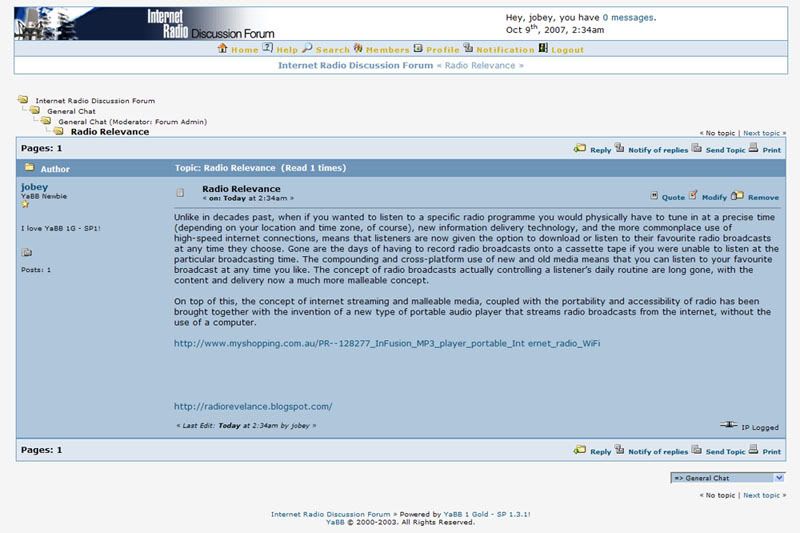
To this day, radio remains as the cheapest, most reliable, most accessible and portable means of news and entertainment delivery. And despite the lack of interactivity and malleability of the delivery and content compared to its peers, it stills works. The radio industry isn't stupid. They know that to tap into a media delivery market that is consuming information a rate that is faster than ever before they have to understand the need for cross-platform media access.
Radio remains an important communication medium through its reach into Australian homes and its ability to satisfy a wide range of listening needs. In some studies, 94% of respondents regularly listen to radio broadcasts and 70% to commercial radio (Koleva, 2003). Although music remains as the most popular form of radio broadcast, especially for the younger demographic, its necessity is being brought into question more and more with cheaper and easier access to portable listening devices; Home/Car CD Players, portable mp3 players. People have more choice of what they want to listen to at any given time, and unlike the early 20th Century, do not have to conform to the contents of the current radio broadcasts.
Despite the increasing ability for music consumers to choose their own music, radio still plays an integral part in the formation and nurturing of popular music cultures. Consumers are often drawn to radio as a base point in forming their own musical identity, and record companies are well aware that radio play will still equal record sales.
This essay has attempted to outline the invention and emergence of in its early stages. Next, it outlined the emergence of radio broadcasts in popular culture and their impact on communication methods worldwide. It then explained the necessity for radio as a means of media delivery, and why it remains a popular source of information. It described radio's introduction into cross-platform media delivery; using the internet and portable telephones as specific examples. Finally, it described the way that consumers are changing their views on radio as a communication device, and growing increasingly indifferent to the content, with views focused firmly on convenience.
Bibliography
Bellis, Mary, The Invention of Radio http://inventors.about.com/od/rstartinventions/a/radio.htm
Hesseldahl, Arik, 2004, Your Radio is Calling http://www.forbes.com/2004/06/04/cx_ah_0604radio.html
Koleva, Milena, 2003, Diversity of Similairity? Specifics of the music formats and the target audiences of the leading commercial radio stations in Brisbane, Griffith University
Lazarsfled, Paul & Kendall, Patricia, 1948, Radio Listening in America, Prentice-Hall Inc.
No comments:
Post a Comment